

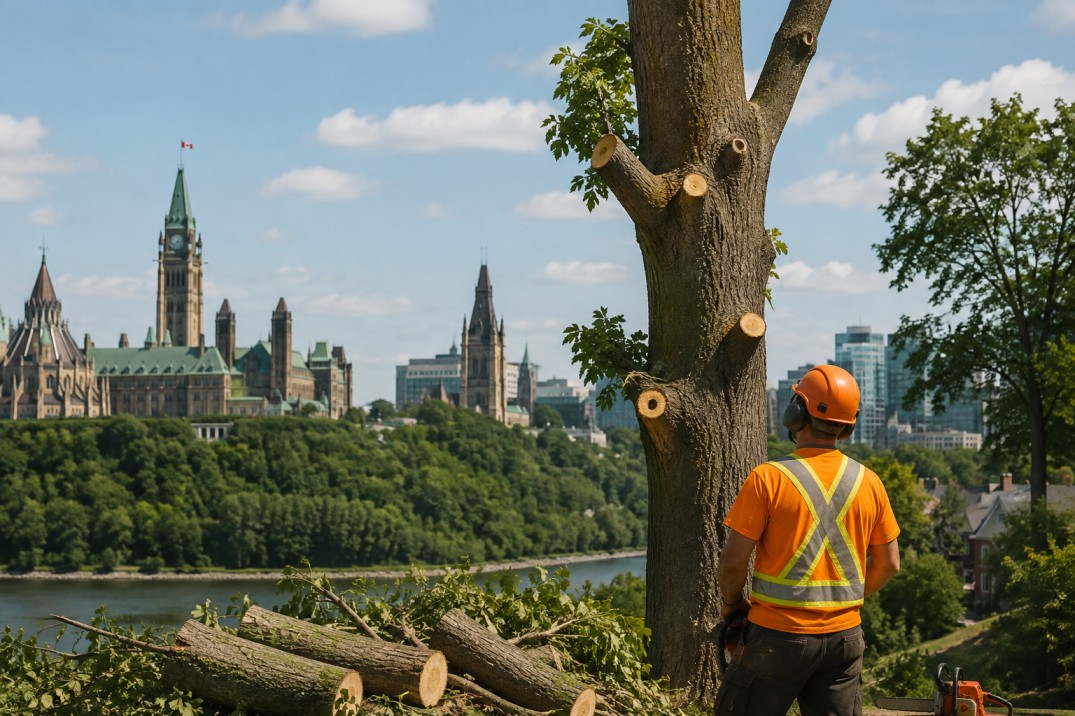
The City of Ottawa approved 96.4% of Tree Protection By-law removal permit applications in its most recently published annual statistics, for removals unrelated to construction. That number comes straight from the City’s own records, not an estimate. Most homeowners assume a permit application is a coin flip. It isn’t, if the paperwork is right.
We pulled the numbers below from the City’s own Tree Protection By-law Annual Tree Removal Permit Statistics, published through Open Data Ottawa. Every figure covers permits issued inside Ottawa’s 24 wards. If you’re in Russell, Casselman, Embrun, Winchester, or one of the other communities we serve outside the City’s boundary, a different bylaw applies (or none at all), and we’ll tell you which one when we assess your property.
How many permit applications actually get approved
Ottawa splits tree removal permits into two tracks that behave very differently.
| Category | Permits issued | Permits denied | Approval rate |
| No Development removals | 1,545 | 58 | 96.4% |
| Infill development removals | 179 | 0 | 100% in this dataset |
Removals unrelated to construction, meaning a dying tree, storm damage, or a tree threatening a foundation, got approved 1,545 times out of 1,603 applications. Fifty-eight were denied. That’s a 96.4% approval rate citywide.
Infill development removals run through a separate track entirely. Of the 179 infill permits issued, 175 were tied directly to construction, not tree condition. If you’re clearing a lot for a new build or a severance, expect a different process and a different fee (below).
Why the City grants a removal permit
The City’s own criteria break down into four categories. Here’s how the 1,545 approved No Development permits split across them.
| Reason on the permit | Number of permits | Share of total |
| Condition of the tree | 1,418 | 91.8% |
| Structural property damage | 82 | 5.3% |
| Development or construction | 43 | 2.8% |
| Right-of-way, water services, city projects | 2 | 0.1% |
“Condition of the tree” covers a tree the City assesses as dangerous, one hit by a vehicle or mechanical equipment, one that’s reached the end of its life, or one with structural problems like large cavities, splits, cracks, or included bark. That single category accounts for nearly all approved non-development removals.
“Structural damage” means the tree is actively damaging a foundation, roof, or underground septic system. That’s a smaller share, about 5%, but it’s the category most homeowners assume dominates.
What a permit actually costs in 2026
Fees changed as of February 1, 2026. Current rates, straight from the City’s tree permits and compensation page:
| Removal type | Fee per tree | Cap |
| Private tree, not tied to infill | $200 | Capped after 5 trees, by ownership |
| Infill development | $1,240 | Capped after 5 trees, by ownership |
| Part of a Planning Act application | Bundled into the development application fee | N/A |
If the removal is approved, the City also requires replacement in most non-development cases: one new tree planted for every one removed, a 1:1 ratio. Development-related removals are compensated differently, sometimes through a valuation formula with a financial payment instead of a replanted tree.
What actually slows an application down
The City doesn’t publish its reasons for denying a permit, so we won’t pretend to know the reasoning behind any individual file. In general, the applications that stall are the ones with an incomplete or vague arborist report, missing photo documentation of the condition or damage being claimed, or a tree that doesn’t clearly meet the distinctive-tree definition in the first place.
A few wards in the dataset show denial rates well above the 3.6% citywide average, one at roughly 12%. That’s not a sign those neighbourhoods have worse trees. It’s a reminder that even in Ottawa, most denials come down to paperwork, not luck.
Why homeowners work with Green Thumb Tree Specialists for the permit process
Ottawa’s own numbers tell you the approval odds. They don’t tell you how to avoid becoming one of the 58 denials, or how to get from application to approved faster than the average homeowner. That’s the part experience handles. Green Thumb Tree Specialists has been navigating the City’s permit process since 2018, and it shows in how quickly our applications move.
A 2-week average, against a 4–6 week industry standard
Our average permit approval takes about 2 weeks. The City’s own approval data above shows why a well-prepared application matters: the difference between a fast yes and a slow one is almost always the quality of the arborist report attached to it.
Riley Sheldrick personally handles the complex permit applications
Riley founded Green Thumb Tree Specialists in 2018 and is an ISA Certified Arborist trained through Arboriculture Canada. He personally handles complex permit applications through the Tree Protection By-law process, and he’s on-site for every high-risk removal.
Emily Sheldrick is your single point of contact with the City
Emily manages permit coordination and every City communication from submission to approval, so you’re never the one chasing down a status update. She confirms with every client after the job is done.
Not sure whether your tree needs a permit, or want someone to handle the paperwork end to end? Request a free assessment and we’ll tell you exactly what’s required before anything comes down. You can also read our full breakdown of how the permit process works or the Tree Protection By-law itself.
Frequently asked questions
Do I need a permit to remove a tree in Ottawa?
If the trunk is 30 centimetres or more in diameter, roughly the width you can’t wrap both arms around, it’s protected under the Tree Protection By-law and needs a permit before removal.
How much does an Ottawa tree removal permit cost in 2026?
$200 per tree for a private removal unrelated to infill development, or $1,240 per tree for infill development removals, both capped after five trees under the same ownership.
How long does it take to get a tree removal permit approved in Ottawa?
It depends on the completeness of the application. Our average is about 2 weeks; industry-wide, 4–6 weeks is more typical when the arborist report needs revisions.
Do I need my neighbour’s consent if the tree is on the property line?
Yes. If the trunk straddles the boundary between two properties, both owners need to consent to the removal before a permit can be issued.
Do I have to replant a tree after removal?
In most non-development removals, yes, at a 1:1 ratio. Development-related removals are sometimes compensated differently.