

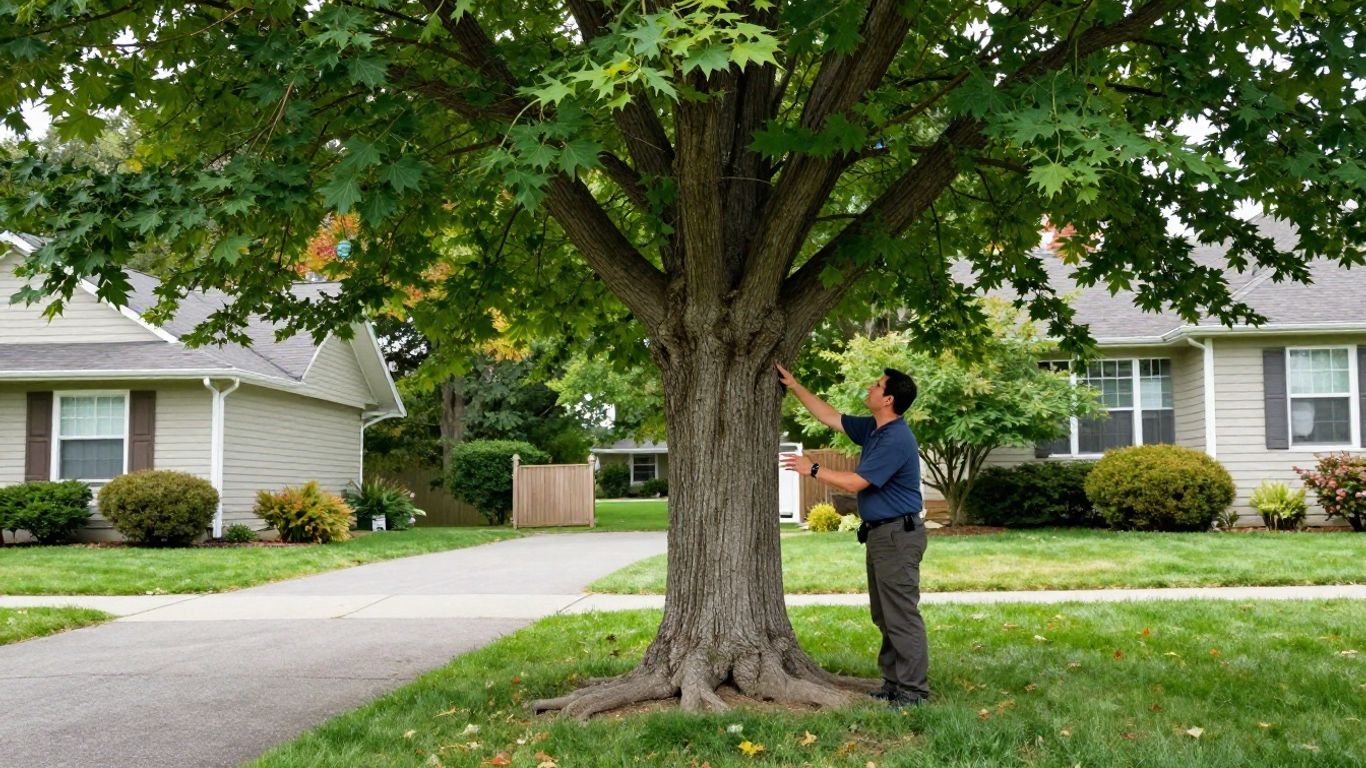
A dead branch, a slight lean, or a patch of thinning leaves is often enough to make a homeowner reach for the phone and ask for a tree to come down. But removal is permanent, and in Ottawa it can also mean navigating the City’s Tree Protection By-law before any cutting happens. Before we recommend removing anything, we walk the site the way an ISA Certified Arborist is trained to: checking the canopy, the trunk, the roots, and everything the tree could fall on if it failed. This guide walks through the same 9-point assessment we use in the field, what each finding actually means, and how Ottawa’s current bylaw thresholds factor into the decision.
Key Takeaways
A careful Ottawa arborist tree assessment looks beyond whether a tree appears old or unattractive. It considers health, structure, roots, surroundings, local rules, and whether removal is truly the safest option.
- A visual inspection can reveal problems that are easy to miss from the ground.
- Dead branches, decay, weak unions, lean, and root damage can all affect risk.
- The tree’s location matters: failure over a house is a different problem than failure in an open yard.
- Ottawa’s Tree Protection By-law sets specific diameter thresholds that may require a permit before removal.
- Pruning, cabling, monitoring, or other measures may resolve the concern without removing the whole tree.
Why Arborists Assess a Tree Before Recommending Removal
Tree removal is permanent, so a responsible recommendation starts with an assessment, not a chainsaw. We examine a tree’s health and structure, then weigh the likelihood and consequences of failure. Those are two different questions: a tree can be unhealthy without being immediately dangerous, or structurally compromised while still carrying a full, green canopy.
During an arborist tree inspection in Ottawa, homeowners often notice we spend as much time looking around the tree as at it. A driveway, play structure, roof, fence, neighbouring property, or overhead utility line changes how much a defect matters. On a recent assessment in Barrhaven, we found a co-dominant stem with included bark on a silver maple, a defect that would have warranted only monitoring in an open backyard, but sat directly above a two-storey addition, which moved our recommendation to cabling within the season.
The assessment gives homeowners a clearer path forward: selective pruning, cabling or bracing, improved soil conditions, ongoing monitoring, or removal. The goal is a defensible decision based on what we can observe, not guesswork.
9 Things an Ottawa Arborist Looks for During a Tree Assessment
A professional assessment moves from the canopy down to the roots and then outward into the surrounding property. The arborist records visible clues, considers how they relate to one another, and decides whether more detailed investigation is warranted. The following nine areas form a practical picture of what happens during an Ottawa arborist tree assessment.
1. The Overall Health of the Tree
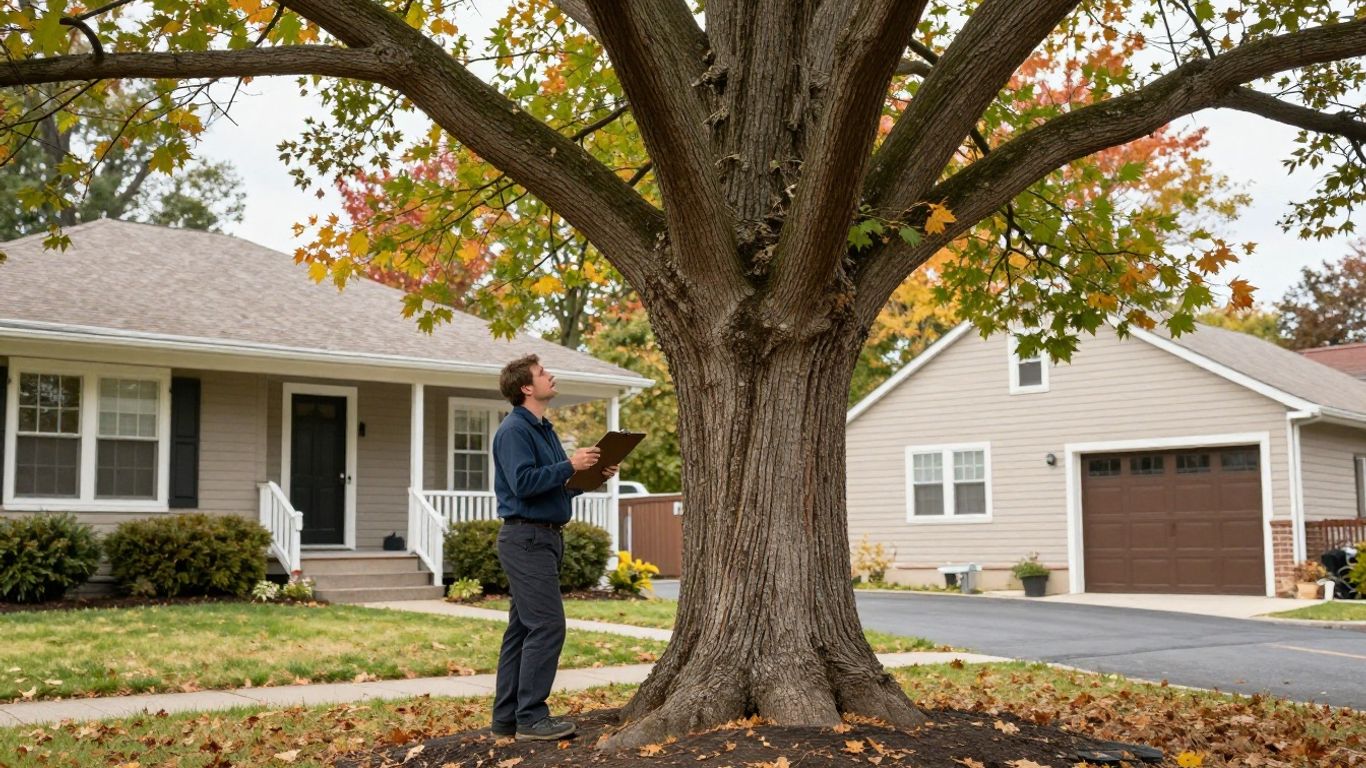
We read the canopy for leaf size, colour, density, new growth, dieback, and uneven thinning, accounting for season and species. Sparse foliage can point to pests, disease, drought stress, root disturbance, or simply the time of year; context decides which.
Health and safety overlap, but they aren’t the same question. A declining tree can remain stable for years, while a tree with a vigorous canopy can still be hiding a dangerous branch union or trunk defect. We keep the two assessments separate so the recommendation matches the actual problem.
2. Dead, Broken, or Hanging Branches
Dead and damaged branches are among the most visible hazards, but position and size decide the urgency. We check whether they sit over a target, whether they’re still attached securely, and whether wind, ice, or heavy snow load is likely to bring them down. A small dead twig over an empty flower bed isn’t equivalent to a large broken limb hanging over a front entrance; the second gets scheduled first. If you’re noticing several dead limbs at once, it’s worth reviewing the signs your tree needs pruning before assuming the whole tree is at risk.
3. Weak Branch Connections and Structural Defects
Included bark, narrow unions, co-dominant stems, and uneven loading make some branches far more vulnerable than others. We study the shape of the union, how weight is distributed, and any evidence of past splitting or corrective pruning to judge whether a limb is likely to fail under stress.
Structure gets assessed as a whole, not as isolated blemishes. A heavy lateral branch, a long exposed limb, and an old crack can combine into more risk than any one feature would create alone. Where the tree’s value justifies it, Tree Cabling & Bracing can reduce the load without removing the whole tree.
4. Cracks, Cavities, and Signs of Decay in the Trunk
Longitudinal cracks, seams, cavities, fungal growth (particularly bracket fungi at the base), loose bark, and soft or hollow-sounding wood can all signal internal or external damage. We trace the defect around the trunk and check whether it connects to a weak union, an old wound, a lean, or visible decay; surface appearance alone rarely tells us how much sound wood is left. Fungal growth can also point to one of the common tree diseases and pests in Ottawa, so we consider disease alongside structural decay.
When a visual inspection can’t answer the question, we’ll recommend a closer diagnostic step, such as sounding the trunk with a mallet or, in higher-stakes cases, a resistograph reading, before landing on a removal recommendation.
5. The Tree’s Lean and Overall Stability
A lean isn’t automatically a failure warning. Some trees grow with a natural lean; others develop one after root disturbance, storm damage, soil movement, or losing a major stem. We check whether the lean is recent, whether soil or roots are lifting at the base, and whether the crown is still balanced over the trunk. A trunk leaning more than roughly 15 degrees from vertical, especially if it’s a new development, is treated as an urgent call.
6. The Root Flare and Visible Root Problems
The root flare, where the trunk widens before meeting the soil, tells us a lot about stability and past site conditions. We look for buried or damaged flare, girdling roots, decay, lifted soil, equipment wounds, and exposed roots vulnerable to further injury. Surface roots that lift a walkway are an inconvenience, not automatically a removal case.
Root problems are often less obvious than canopy problems. A tree can still look full and green while nearby construction, grade changes, compaction, or excavation have quietly reduced its support underground.
7. The Critical Root Zone and Soil Conditions
Soil is part of a tree’s support system, not just its growing medium. We check for compaction, drainage issues, erosion, recent excavation, grade changes, and any sign that roots have been cut or covered; conditions that can explain poor growth and affect how securely the tree is anchored.
This matters most when a driveway, pool, addition, or landscaping project is planned nearby. Avoiding tree damage during construction before work starts is far cheaper than discovering the damage a year later.
8. The Tree’s Location and What Surrounds It
Risk depends on the tree and on what could be struck if it, or a branch, came down. We identify targets: homes, garages, vehicles, fences, sidewalks, roads, gathering areas, and how often people or property pass through that space. A tree beside a rarely used shed is a different practical concern than one beside a front walkway used daily.
This is also where the assessment becomes a site visit rather than just a tree inspection. We’re checking access, nearby trees, utility conflicts, slope, and how much room a crew would need for pruning or removal, since that affects both feasibility and cost.
9. Tree Size, Condition, and Removal Requirements in Ottawa
Size affects both the consequences of failure and the complexity of the work itself. We factor in trunk diameter, height, canopy spread, condition, access, and nearby obstacles before treating removal as a practical option. An 80-foot hardwood wedged between a house and a fence line, something Riley has handled repeatedly around Kanata and Nepean, needs cranes and rigging, not a straightforward felling plan.
Ottawa homeowners should also confirm whether the proposed work falls under the City’s Tree Protection By-law before scheduling anything. Removal without the required permit can lead to significant fines, and a private yard doesn’t automatically mean unrestricted removal.
Assessment findings at a glance:
| Assessment finding | Possible concern | Question we resolve |
|---|---|---|
| Dead or broken limb | Localized branch failure | Can it be pruned safely, or does it need immediate removal? |
| Trunk cavity or crack | Reduced structural strength | Is sounding or resistograph testing needed? |
| Root disturbance | Lowered stability or vitality | Was there recent excavation or compaction nearby? |
| Large tree near a target | Greater consequence if failure occurs | Can the target be protected, or does the tree need to come down? |
This table isn’t a substitute for a site visit; it shows why one symptom rarely tells the whole story. The recommendation connects the finding, the likely risk, and the most proportionate next step.
Not sure which category your tree falls into? Try our Price Calculator for an instant estimate on pruning, cabling, or removal, based on the details above.
What Ottawa’s Tree Protection Rules Mean for Homeowners
Ottawa’s Tree Protection By-law can affect private-property tree removal once a tree reaches a size threshold, or when development activity is involved. The bylaw is separate from an arborist’s technical opinion. We can tell you the tree’s condition and risk; the City’s process determines what approval is required. Checking both sides early avoids an expensive delay mid-project.
When a Tree May Require a Permit Before Removal
Under the current by-law, a tree removal permit is generally required for:
- Trees 30 cm or more in diameter at breast height (DBH) on private property in the urban area inside the Greenbelt
- Trees 50 cm or more DBH in the suburban area outside the Greenbelt
- Trees 10 cm or more DBH on properties over 1 hectare, or where removal is tied to a Planning Act application (Site Plan, Plan of Subdivision, or Plan of Condominium)
- All City-owned trees, regardless of diameter
Exemptions exist. For example, a tree that poses an immediate threat to public health and safety, or a confirmed emerald ash borer infestation, may not require a permit, though documenting the condition (photos, an arborist note) before removal is still wise. Don’t rely on a neighbour’s situation as proof the same exemption applies to your property; the diameter, ownership, and reason for removal all factor in. For a fuller walkthrough of when homeowners can and can’t remove a tree without City sign-off, see do I need permission to cut down my own tree?
As of February 1, 2026, permit application fees are $200 per tree for non-infill removals and $1,240 per tree for removals tied to infill development, capped after five trees under the same ownership.
Why Tree Diameter Matters in Ottawa
Diameter is the City’s consistent yardstick for deciding which trees fall under protection, but measuring it correctly matters. DBH is measured at approximately 1.4 metres (chest height) from ground level, and whether the property sits inside or outside the Greenbelt changes which threshold applies (30 cm vs. 50 cm). A rough guess from a photo is enough to raise the question, not enough to settle it. For the full breakdown of thresholds, exemptions, and fees, see our Ottawa Tree Protection Bylaw guide.
For a private tree removal application, record the tree’s location, ownership, diameter, condition, and reason for removal before contacting the City or an arborist. If the trunk straddles a property line, confirm ownership with your neighbour first; a shared tree generally needs both owners’ consent.
Does a Tree Always Need to Be Removed?
No. Removal is one possible outcome of an assessment, not the default one. Depending on the defect and the target, we may recommend deadwood removal, crown reduction, selective pruning, cabling, bracing, site changes, or a period of monitoring instead.
A tree with a manageable branch defect can keep providing shade and habitat after targeted work. A tree with extensive decay, major root loss, or an unstable attachment directly over a home has fewer realistic options. Four questions tend to clarify which situation you’re in:
- Which defect creates the greatest concern?
- What target would be exposed if the tree or branch failed?
- Could pruning, support, or a site change reduce the risk to an acceptable level?
- What signs would justify a follow-up inspection?
What Happens After an Arborist Completes the Assessment?
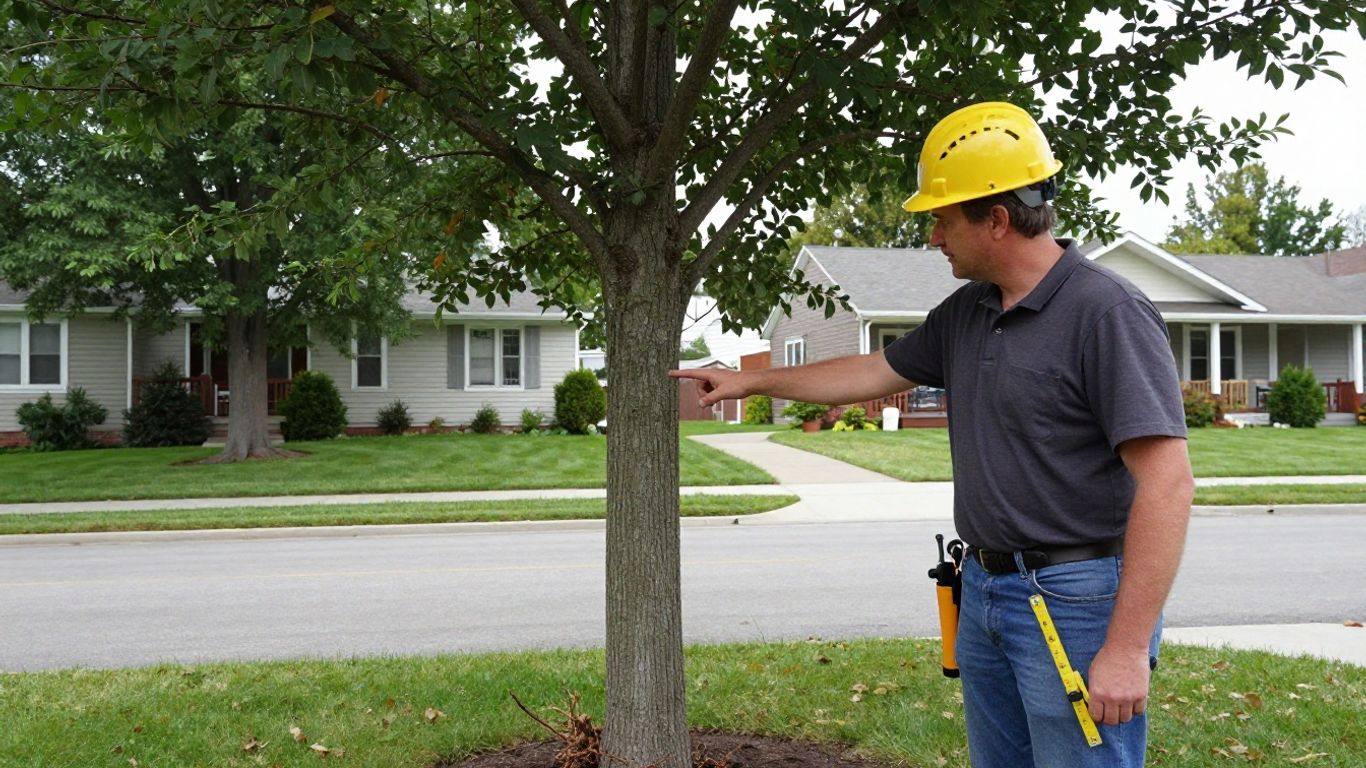
After every site visit, the Green Thumb Tree Specialists team explains the observations in plain language and connects them to a recommendation: an immediate hazard response, scheduled pruning, further diagnostics, monitoring, or removal, along with the reasoning, the urgency, and any limits of what a single visit could determine.
Depending on the situation, you may receive written findings, photographs, measurements, or a formal report for insurance, a property sale, construction planning, or a permit application. Keep those records with your other property documents, particularly if the tree sits near a boundary or a planned project.
If removal is the outcome, the job isn’t finished when the trunk comes down. A leftover stump can attract pests and create tripping hazards, so it’s worth deciding upfront why you shouldn’t leave a tree stump in the ground as part of the same work plan.
Conclusion
Before the first cut, a proper assessment gives an Ottawa homeowner a clear picture of the tree, the site, and the realistic choices available. Looking at health, structure, roots, targets, size, and current bylaw requirements can prevent both unnecessary removal and an overlooked risk. When removal is the right call, the assessment also makes sure the work starts with accurate information, and, where a permit applies, a compliant application from day one.
Frequently Asked Questions About Tree Assessments in Ottawa
How does an arborist determine if a tree is dangerous?
We weigh visible defects, decay, branch attachments, root and soil conditions, lean, overall health, and the people or property that could be affected if the tree or a branch failed. Danger isn’t decided by one symptom alone. It’s a judgment about the likelihood of failure combined with the consequences at that specific location.
Can a tree with dead branches still be saved?
Often, yes. If the dead wood is limited to a few branches and the rest of the canopy, trunk, and root system are sound, targeted pruning can remove the hazard while the tree stays healthy. The exception is when deadwood is widespread or points to a deeper issue, such as root damage or disease; in that case, the dead branches are a symptom, not the whole problem.
How do arborists check a tree’s roots?
We start above ground: root flare condition, girdling roots, soil heaving, exposed or wounded roots, and any signs of recent excavation or compaction nearby. Where root damage is suspected but not visible, we may probe the soil or, on higher-value or higher-risk trees, recommend an air spade investigation to expose the root system without cutting through it.
Why does an arborist measure the trunk before tree removal?
Trunk diameter, measured at breast height, about 1.4 metres up, determines whether the tree falls under Ottawa’s Tree Protection By-law thresholds (30 cm in the urban area, 50 cm in the suburban area, or 10 cm on larger properties and Planning Act sites). It also affects the complexity, equipment, and cost of the removal itself, so it’s one of the first measurements we take.
Does every tree in Ottawa require a permit for removal?
No. Only trees that meet the City’s protected-tree thresholds, or that are City-owned, need a permit. Smaller private trees below the diameter threshold, and trees that pose an immediate safety threat, are generally exempt, though documenting the condition before removal is still good practice. When in doubt, confirm with the City or ask us to check during your assessment.
Ready for a professional read on a specific tree? Request a free assessment and an ISA Certified Arborist will walk the site with you, no pressure, no obligation.